Talking Science Podcast
The Fermi Paradox – Where Is Everybody?
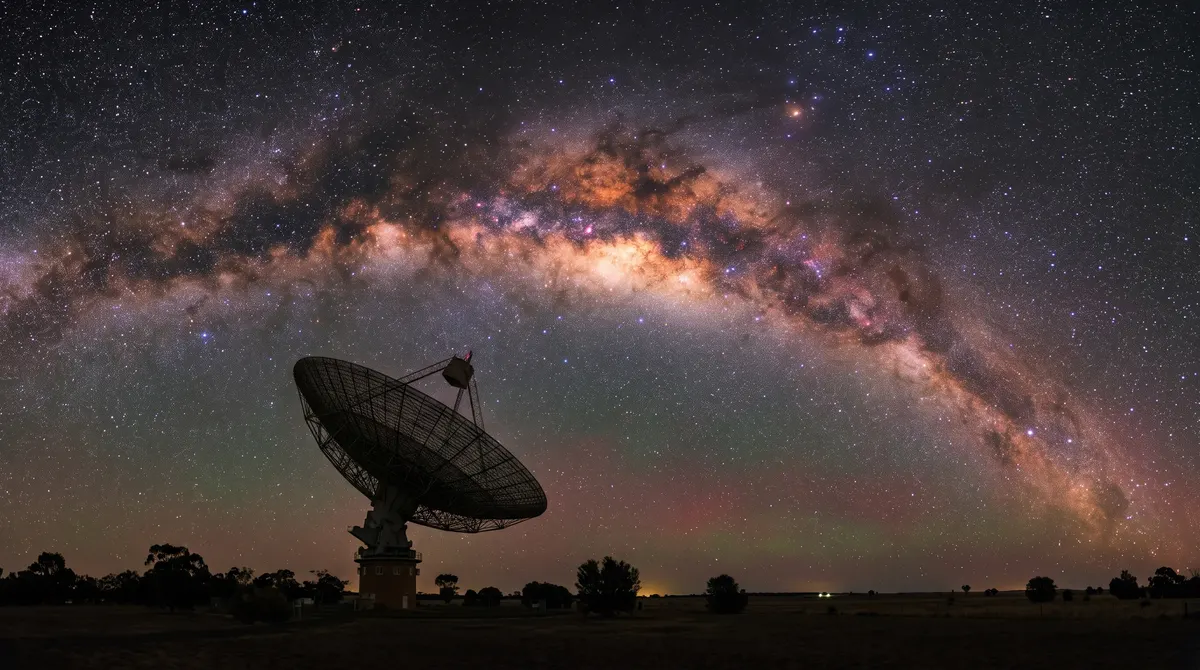
Lie on your back somewhere dark, away from the city lights, and the sky fills up with more stars than you can count. Out in the bush on a clear night the Milky Way stretches overhead like a band of smoke, and every one of those points is a sun. It is almost impossible not to wonder whether someone, somewhere out there, is looking back.
The strange thing is that the more we learn about the universe, the more that question sharpens into a genuine puzzle. By most reasonable estimates the galaxy should be crowded with life. Yet when we look and listen, we find nothing at all. That clash has a name: the Fermi paradox.
A Question Over Lunch
In 1950 the physicist Enrico Fermi was chatting with colleagues at lunch about recent reports of flying saucers and the chances of alien life. Partway through, he reportedly asked, more or less, "But where is everybody?" It sounds like an offhand remark, and it may have been. But it captures a problem scientists still argue about.
The paradox is the collision between two things that both seem true. The first is that the universe ought to be full of life. The second is that we have found no sign of any.
Why the Galaxy Should Be Busy
The case for a crowded galaxy is surprisingly strong. The Milky Way contains a few hundred billion stars, and a great many are broadly like the Sun. Thanks to planet-hunting telescopes, we now know that planets are common, and that billions of them probably orbit in the habitable zone, the band around a star where temperatures could allow liquid water. The story of how those worlds were found is told in Exoplanets – Finding Worlds Around Other Stars.
The galaxy is also old, roughly thirteen billion years, which leaves an enormous stretch of time for life to arise and develop. The same chemistry operates everywhere. So if even a tiny fraction of suitable planets produced life, and a tiny fraction of that life became intelligent and technological, there should be many civilisations out there, some of them far older than ours.
Then comes the part that really sharpens the puzzle. A civilisation only a little more advanced than us, able to build slow starships or self-copying probes, could in principle spread across the whole galaxy in a few million years. That sounds like a long time, but against the age of the galaxy it is a blink. Even one expanding civilisation, arising once in all that history, could have reached everywhere by now, including here. Instead we see no signals, no probes and no obvious cosmic engineering.
The Drake Equation: A Map of Our Ignorance
In 1961 the astronomer Frank Drake wrote down a simple string of factors that, multiplied together, would give the number of civilisations in our galaxy that we might be able to detect. It asks how often stars form, how many have planets, how many of those planets are habitable, how often life starts, how often it becomes intelligent, how often intelligence develops technology, and how long such civilisations last.
It is an elegant way of organising the question, but it is not a machine that produces an answer. We are starting to pin down the first few factors, the ones about stars and planets. The ones about life and intelligence are, for now, close to pure guesswork. Feed in optimistic numbers and the galaxy teems. Feed in pessimistic ones and we are alone. The equation's real value is in showing which unknowns matter most.
Three Families of Explanation
Proposed answers to the paradox tend to fall into three broad groups, and each says something different about our own prospects.
- They are not there. Technological life may be genuinely rare, and we might be the only such civilisation in the galaxy, at least right now. In that case the silence is exactly what you would expect.
- They are there, but we cannot see them. Perhaps they are not broadcasting, or not in ways we can detect. Perhaps the distances and costs of travel keep everyone at home, or they simply have no interest in a young world like ours.
- They arise, but they do not last. Something may reliably stop civilisations before they spread.
The Great Filter
That third possibility has a memorable name: the Great Filter. The idea is that somewhere on the road from lifeless chemistry to a galaxy-spanning civilisation there is at least one step that is extraordinarily hard to get past, one that almost every world fails.
The unsettling part is that we do not know where the filter sits. If it is behind us, perhaps at the origin of life itself or the leap to complex cells, then we have already made it through and may be genuinely rare. That would be a hopeful reading. If the filter lies ahead, perhaps because civilisations tend to destroy themselves through war, environmental collapse or some technology not yet invented, then the empty sky becomes a warning. This is why the paradox is more than idle speculation. Depending on the answer, the silence is either reassuring or ominous.
How Little We Really Know
It is easy to discuss all this with more confidence than it deserves. We have exactly one example of life, here on Earth, and one example of a technological species. You cannot do statistics on a sample of one. We do not know whether life is a freak accident or an almost inevitable result of the right chemistry.
The search itself is also very young. Serious listening for alien signals has only gone on for a few decades, with limited instruments, covering a small slice of the sky and a narrow range of radio frequencies. Australia has played a real part, with the Parkes radio telescope, Murriyang, in the central west of New South Wales, contributing to the Breakthrough Listen project. Even so, the total searched so far has been compared to scooping a single glass of water from the ocean and concluding there are no fish. Absence of evidence, at this stage, is not strong evidence of absence. The wider hunt for life, from Mars to icy moons, is covered in The Search for Life Beyond Earth.
Gentler Possibilities
Not every explanation is dark. We might simply be early, one of the first technological civilisations in a universe that will host many more long after the Sun has gone. Or civilisations might flare up and fade at different times and places, like ships passing in a night that lasts billions of years, never overlapping. Neither idea can be proved, but they are no less reasonable than the gloomier ones, and it would be a mistake to let the scariest reading crowd out the rest.
An Open Question Worth Keeping
Fermi's question remains unanswered, and that is part of what makes it so powerful. It turns out to be a question about biology, physics, the lifespan of civilisations and, quietly, about ourselves. Every new exoplanet, every improvement in our listening equipment and every clue about how life began chips away at the unknowns. We may never get a final answer, but asking has already sharpened how we think about our place in the cosmos, and the silence overhead may simply be the sound of a universe we have only just started to explore.