Talking Science Podcast
The Future of Human Spaceflight – Who Actually Goes?
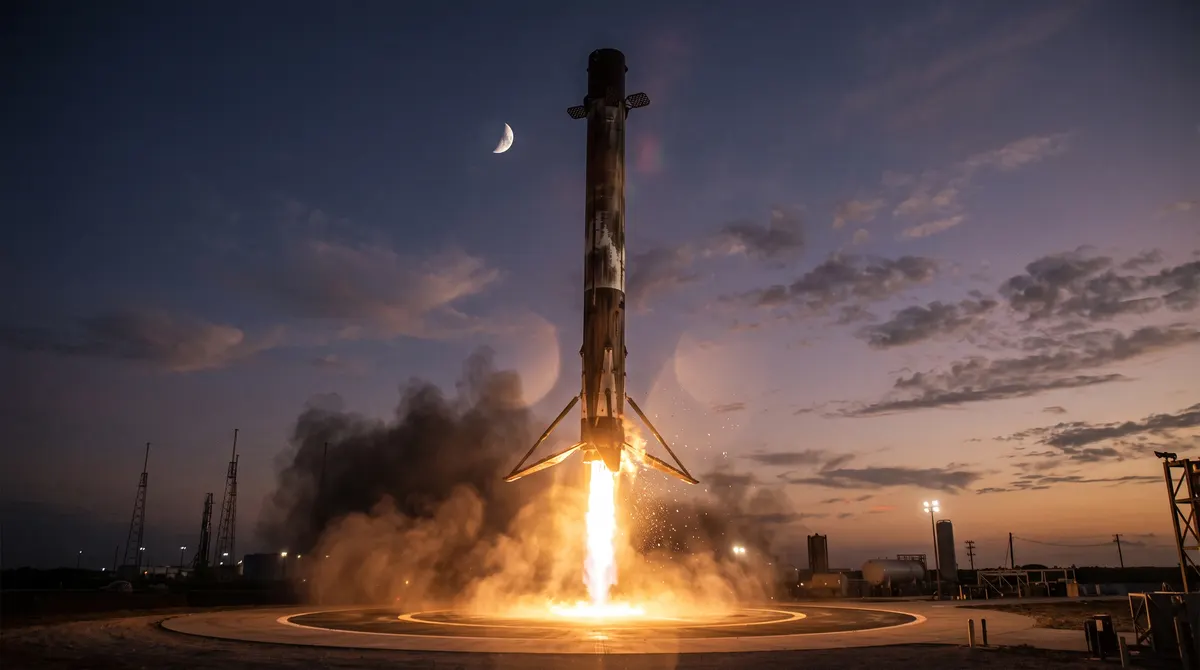
Watch footage of a rocket launch from a decade or two ago and the ending was always the same. The rocket climbed, the stages fell away, and the spent hardware tumbled into the sea, never to fly again. Watch a launch now and there is a good chance the most expensive part of the rocket comes back, drops out of the sky and lands upright on a pad or a ship, ready to be flown again.
That single change sums up how much human spaceflight has shifted. For most of the space age, going to space meant a small number of government astronauts riding throwaway rockets, mostly to low Earth orbit a few hundred kilometres up. Today the questions of who goes, how they get there and why are wide open. It is worth taking an honest look at where things really stand, separating what is genuinely happening from what is still glossy ambition.
The Quiet Revolution of Reusability
The biggest change has a boring-sounding name: reusability. Traditionally a rocket was a one-shot machine. You built an extraordinarily precise vehicle, flew it once and threw it away. Imagine scrapping a jumbo jet after a single flight between Sydney and Melbourne and the economics become obvious.
Rockets whose main stages fly back and land, to be refuelled and reflown, have changed that. When the most expensive part of the vehicle can be reused, the cost of putting each kilogram into orbit can fall dramatically. The physics did not get any easier. As explained in How Rockets Actually Work, reaching orbit is still brutally demanding. What changed was the economics, and cheaper access to orbit means more launches, more satellites, more players and more room to imagine sending people beyond the usual handful of professionals.
Private Companies Take the Wheel
That economic shift opened the door to private companies. For decades human spaceflight was almost entirely the business of national programs. Now companies build many of the vehicles, and agencies increasingly buy rides and services rather than owning everything themselves. Competition and commercial pressure have driven real innovation and sped things up.
It has also raised new questions. Who sets the safety standards? Who is accountable when something goes wrong? And what should we make of space tourism, where people wealthy enough can buy a brief hop to the edge of space or a few days in orbit? It is fair to feel mixed about that. It is a real capability, but it is a long way from the grand exploratory purposes space travel is usually sold on.
Australia is part of this changing picture in its own way. The Australian Space Agency was set up in 2018, and Katherine Bennell-Pegg became the first astronaut trained under the Australian flag after completing the European Space Agency's astronaut training in 2024. These are early steps, but they show how many more countries and people now have a stake in human spaceflight.
Back to the Moon, This Time to Stay
The nearest big goal is a return to the Moon. The Apollo astronauts last walked there in 1972, and the stated aim now is not to plant a flag and leave but to build a lasting presence. NASA's Artemis program flew its first, uncrewed test mission around the Moon in late 2022, with crewed flights planned to follow, first circling the Moon and later landing.
The target is the region near the lunar south pole, because water ice is trapped in craters there that never see sunlight. Water is the most precious resource in space. It can be drunk, split into breathable oxygen, and its hydrogen and oxygen can be turned into rocket propellant. A base that could tap local ice would be far more sustainable than one shipping every drop from Earth.
It is worth being clear-eyed. These programs have repeatedly slipped their schedules, they are enormously expensive, and promised dates for returning to the Moon have a long history of moving. The hardware is real and being tested, but specific near-term dates deserve caution.
Mars: Separating Engineering from Salesmanship
Mars captures imaginations like nothing else, and it also attracts the most breathless talk. Sending people there is vastly harder than going to the Moon. The Moon is about three days away. Mars is many months each way, and the planets line up favourably only about every two years, so a crew would be committed to a mission lasting well over a year and possibly closer to three.
Over that time, serious problems pile up:
- Radiation. Beyond Earth's protective magnetic field, astronauts are exposed to cosmic rays and solar particles that raise cancer risk, and we cannot yet fully shield against them on a long voyage.
- Weightlessness. Long stays in orbit cause bone loss, muscle wasting, fluid shifts and effects on the eyes and heart, which have been studied on the space station but never over a multi-year round trip. The details are covered in Living in Space – What Zero-G Does to the Body.
- Landing. Mars has an awkward atmosphere, too thick to ignore but too thin to slow a large, heavy lander easily.
- Self-sufficiency. A crew would need to stay alive, healthy and sane with no hope of quick rescue, hundreds of millions of kilometres from home.
None of these is necessarily unsolvable, and capable people are working on all of them. But a crewed Mars landing is not a next-few-years project in the way some public statements imply, and confident talk of large Mars settlements within a decade or two is better treated as aspiration than schedule. Real progress is being made. The timeline is routinely oversold.
Why Send People at All?
All of this raises a bigger question. Robotic probes and rovers have explored the solar system brilliantly, at a fraction of the cost and with no risk to human life. A rover needs no air, food, water or ticket home. Many scientists argue, reasonably, that for pure science robots deliver far more value per dollar.
The counter-argument rests partly on things that are harder to measure: the human urge to go ourselves, the inspiration and technologies that crewed programs generate, and the long-term idea of humanity living beyond one planet. Thoughtful people hold both views sincerely. There is no single correct answer, because it depends on what you believe space programs are ultimately for.
Hopeful Realism
Human spaceflight is more dynamic now than it has been in decades. Reusable rockets have changed the economics, private companies have quickened the pace, a return to the Moon is being actively built towards even as the dates slip, and Mars sits on the horizon as a real long-term goal wrapped in a good deal of premature hype. The most useful stance is hopeful realism: excited by what reusability and competition have unlocked, clear-eyed about how hard it is to keep fragile human bodies alive far from Earth, and sceptical of any confident date attached to the hardest goals. The frontier is opening, just more slowly and more expensively than the boldest promises suggest.