 Talking Science Podcast
The Great Barrier Reef – A Living Wonder Under Pressure
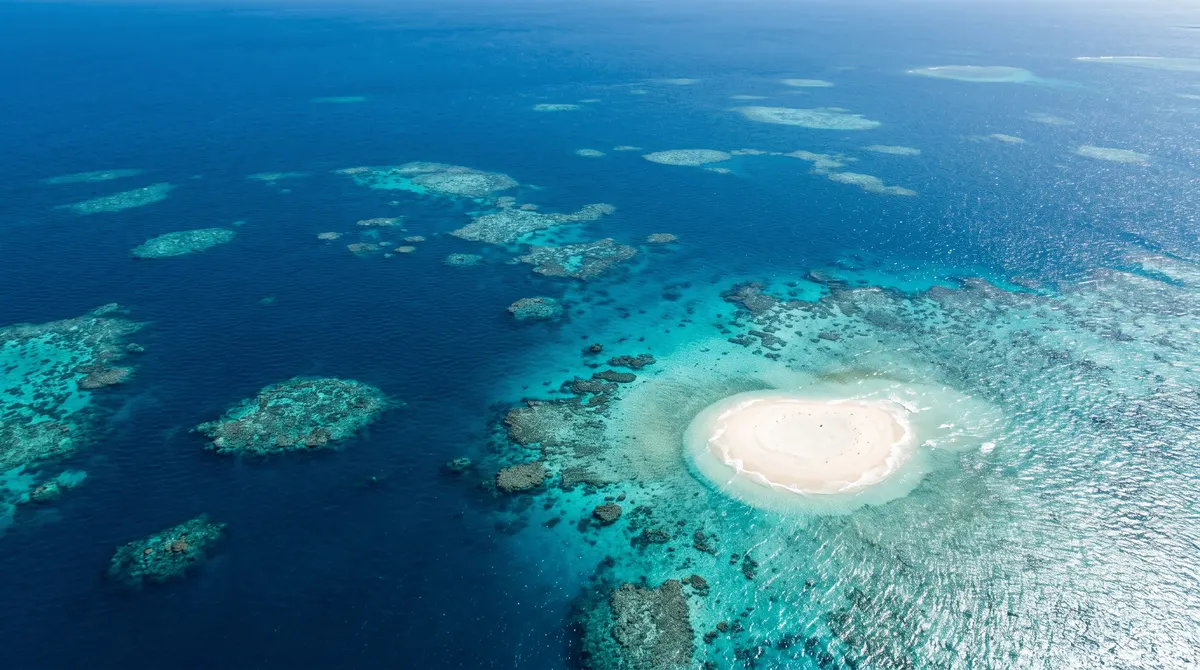
Fly north out of Cairns or Mackay on a clear day and look out the window. Below, the sea shifts from deep navy to an impossible turquoise, scattered with pale shapes like puzzle pieces dropped across the water. Those shapes are reefs, thousands of them, and together they make up the largest structure ever built by living things on Earth.
The Great Barrier Reef is an Australian icon and a World Heritage area, and it sits at the centre of one of the most closely watched environmental stories in the world. It is also a subject where both alarm and reassurance are regularly overstated, so it is worth looking carefully at what the reef is, how it formed and what the science says about its future.
Not One Reef but Thousands
The Great Barrier Reef runs for more than two thousand kilometres along the Queensland coast, from the tip of Cape York down past Gladstone. It is not a single wall of coral but a vast, interlocking system of nearly three thousand individual reefs and hundreds of islands and cays, spread across an area larger than many countries. It is big enough to be picked out from orbit.
Some reefs sit close to the mainland in murky coastal water. Others lie far offshore near the edge of the continental shelf, where the water is clear and the seafloor drops away into the Coral Sea. Conditions vary enormously from one end to the other, and that variety turns out to matter a great deal when trouble arrives.
Built by Animals You Could Balance on a Fingertip
All of this was made by tiny animals. A coral is a colony of thousands of polyps, each only millimetres across and related to jellyfish and sea anemones. Each polyp draws dissolved minerals from seawater to build a hard limestone skeleton beneath itself. Over countless generations those skeletons pile up, and the living coral ends up as a thin, coloured skin on top of a mountain built by its ancestors.
The reef we see today has grown over roughly the last six to eight thousand years, since sea levels rose at the end of the last ice age, and it sits on the foundations of older reefs that grew and died during earlier highs and lows of the sea. The biology of how corals work in general is explored in Coral Reefs – Rainforests of the Sea. Here the focus is on this particular reef and the pressures it faces.
A Partnership That Can Break
The reef's colour and productivity depend on a partnership. Living inside coral tissue are microscopic algae that use sunlight to make sugars, handing most of them to the coral as food. In return the coral gives them a safe, sunlit home. This symbiosis lets reefs flourish in clear tropical water that is otherwise poor in nutrients. The algae also provide most of the colour, since the coral animal itself is nearly transparent.
When the water becomes too warm, often just one or two degrees above the usual summer maximum for a few weeks, the algae's photosynthesis starts to go wrong and produces substances harmful to the coral. The coral expels them. Without its algae it loses both its colour and its main food supply, and the white skeleton shows through. This is bleaching.
A bleached coral is not a dead coral. It is a starving, stressed one. If the water cools soon enough, the algae can return and the coral can recover. If the heat is severe or lasts too long, the coral runs out of energy and dies.
Why the Frequency Worries Scientists
The Great Barrier Reef experienced mass bleaching in 1998 and 2002, then again in 2016, 2017, 2020, 2022 and 2024. Any single event is something reefs have survived before. What concerns researchers is the shrinking gap between them.
Coral takes time to recover. Slower-growing species can need a decade or more to rebuild the complex structures that shelter fish and other animals. When severe bleaching arrives every few years instead of every few decades, reefs lose the breathing space they need between blows. The underlying driver is ocean warming, which lifts the baseline so that normal summer peaks and marine heatwaves cross the danger line more often. The link between rising sea temperatures and more frequent, more severe bleaching is one of the better-established findings in reef science, and the physics behind that warming is laid out in Climate Change – The Physics Behind It.
Heat is not the only pressure. Cyclones can smash reefs apart, outbreaks of coral-eating crown-of-thorns starfish can strip large areas, and sediment and fertiliser washing off the land can cloud inshore waters. These stresses add up, and a reef weakened by one is less able to cope with the next.
Neither Dead Nor Fine
This story is often told badly in both directions. Some say the reef is effectively dead. That is not accurate. The reef is enormous, its condition varies dramatically from place to place, and in some years and regions coral cover has rebounded strongly when conditions allowed, at times reaching the highest levels recorded in decades of monitoring.
That recovery is sometimes held up as proof there is no problem, which is equally misleading. Much of the rebound has come from fast-growing table and branching corals, which are especially vulnerable to the next heatwave and to starfish. A high coral cover figure can therefore be more fragile than it looks. The honest picture is more interesting than either headline: a dynamic system under real and growing pressure, capable of striking recovery, but facing disturbances arriving faster than that recovery can comfortably keep up with.
The Science of Watching and Helping
The Australian Institute of Marine Science has surveyed reef condition year after year for decades, producing one of the best long-term records of any reef system on Earth. Alongside that monitoring, researchers are:
- studying heat-tolerant corals and heat-tolerant strains of their algae
- trialling coral gardening and restoration on damaged sites
- exploring ways to help corals adapt to warmer water
- experimenting with methods to shade or cool small patches of reef during extreme heat
These efforts currently work at tiny scales compared with the size of the reef, and none of them replaces dealing with the ocean warming behind the problem. But they are careful science, and they help reveal how much resilience the reef really has.
Why It Matters
The reef is home to thousands of species of fish, corals, molluscs and other animals. It underpins a major part of the Queensland economy through tourism and fishing and supports tens of thousands of jobs. It helps protect the coast from storm waves. And it holds deep cultural significance for the many Aboriginal and Torres Strait Islander Traditional Owner groups whose connections to these waters go back many thousands of years, to a time when parts of today's reef were dry land.
So the next time that turquoise sprawl appears in a photograph or a plane window, it is worth holding the full picture in mind. It is a structure thousands of years in the making, built grain by grain by tiny animals and their algae, resilient and genuinely threatened, intensively studied, and far too important to reduce to a single cheerful or gloomy headline.


