Talking Science Podcast
Titan – The Moon with Rivers of Methane
Natural gas is so ordinary that most of us never think about it. It hisses out of the stovetop, burns blue, and heats the kettle. Its main ingredient is methane, a simple molecule that on Earth is always a gas. Now imagine a world so cold that methane falls from the sky as rain, gathers into rivers and fills lakes, while water sits frozen as hard as granite underfoot.
That world is real. It is Titan, Saturn's largest moon, and despite its very different ingredients it is one of the most strangely Earth-like places in the solar system, with thick air, rain, rivers, seas, seasons and quite possibly a hidden ocean of real water.
A Moon Bigger Than a Planet
Titan is huge by moon standards, larger than the planet Mercury, although less massive because it is a blend of ice and rock rather than dense metal and stone. It orbits Saturn at about 1.2 million kilometres, taking roughly sixteen days per lap, and like our own Moon it is tidally locked, always showing the same face to its planet.
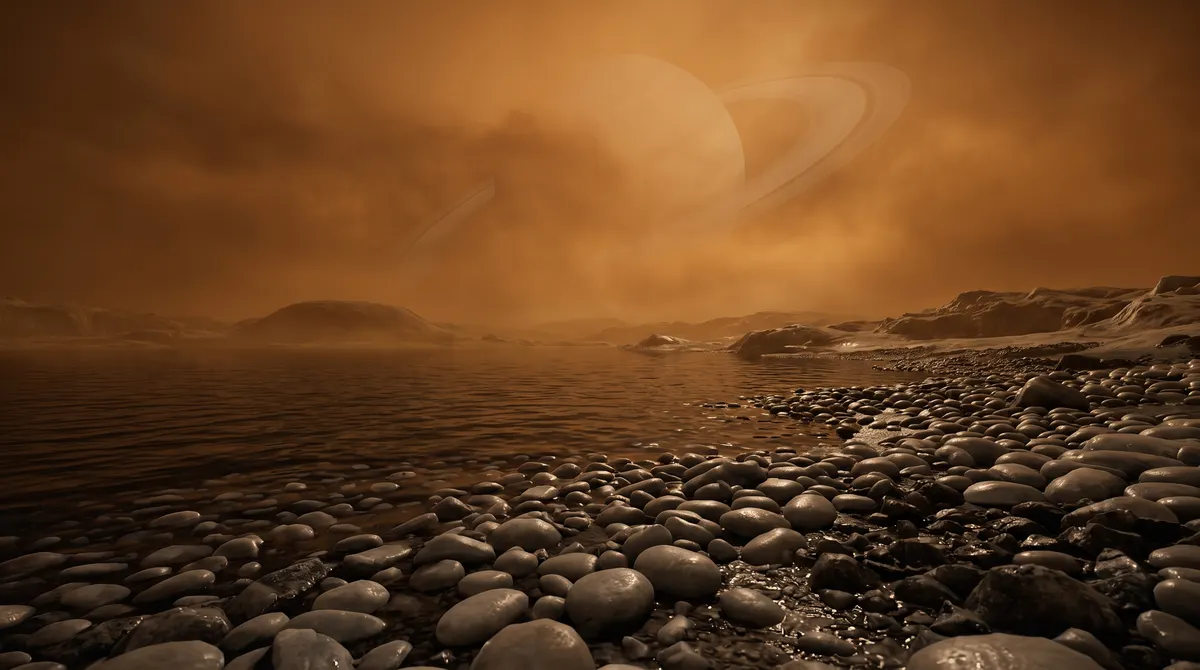
Out at Saturn, nearly ten times further from the Sun than Earth, sunlight is feeble and the surface sits at around minus 180 degrees Celsius. At that temperature water ice behaves like rock: hard, brittle and immovable. Titan's pebbles, boulders and low rounded hills are made of it.
The Dutch astronomer Christiaan Huygens spotted Titan in 1655 with a telescope he built himself. In the 1940s, astronomers using spectroscopy, which spreads light into its colours to reveal the chemicals present, found methane around it. No other moon was known to have a real atmosphere.
Air Thick Enough to Fly In
Titan's atmosphere is mostly nitrogen, the gas that makes up about 78 per cent of our own air, with a small but crucial share of methane. Surface pressure is roughly half again Earth's at sea level, and gravity is only about one-seventh of ours.
Put dense air and weak gravity together and you get something extraordinary: a person wearing a decent pair of strap-on wings could, in principle, flap their way into the sky on muscle power alone. That is essentially impossible anywhere else we know of.
From space, Titan is a smooth orange ball. High in its atmosphere, weak sunlight breaks methane apart, and the fragments recombine into complex molecules of carbon, hydrogen and nitrogen called tholins. They drift down as haze and have piled up into vast fields of dark dunes across the equator, shaped like desert dunes but made of something closer to soot than sand. This carbon chemistry makes Titan a natural laboratory for reactions that may have happened on the early Earth, even though it is far too cold for them to go as far.
Methane Rain and Hydrocarbon Seas
Titan has a full weather cycle that mirrors Earth's water cycle, with methane and its close relative ethane playing the part of water. Faint sunlight evaporates liquid methane, clouds form, and now and then methane rain falls, carving river channels that drain into lakes and seas, mostly near the poles.
The largest, Kraken Mare, is roughly the size of the Caspian Sea, with smaller neighbours named Ligeia Mare and Punga Mare. Radar on NASA's Cassini spacecraft, which could see through the haze, revealed them, and parts of the bigger seas appear to be more than a hundred metres deep.
Rain seems to be a rare, seasonal event in most places, more like an occasional desert downpour than daily drizzle. Saturn takes about 29 Earth years to orbit the Sun, so each of Titan's seasons lasts roughly seven years.
Landing on Another World
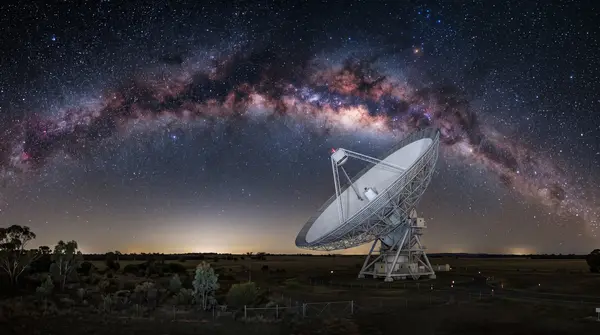
Our only ground-level view of Titan comes from the Huygens probe, built by the European Space Agency and carried to Saturn aboard Cassini, a joint NASA, ESA and Italian Space Agency mission that arrived in 2004 and studied Saturn for thirteen years. NASA's Deep Space Network, including its tracking station near Canberra, kept in contact throughout.
In January 2005, Huygens parachuted through Titan's air for more than two hours and touched down, the first spacecraft to land on a world in the outer solar system. On the way down it photographed branching channels strikingly like river systems on Earth. On the ground it saw rounded pebbles of water ice, smoothed as if by flowing liquid. It lasted only hours before the cold overwhelmed it. Cassini was later plunged into Saturn in 2017 so it could never contaminate a potentially habitable moon.
The Ocean Under the Ice
Beneath Titan's crust there is very probably a second ocean, this time of liquid water. During close flybys, Cassini's radio team measured tiny changes in the spacecraft's path caused by Titan's gravity, and other measurements tracked how the icy shell flexes and wobbles as Saturn tugs on it. Both point to a global layer of water sandwiched between an outer ice shell and, most likely, a rocky core.
That water is probably kept liquid by dissolved ammonia acting as antifreeze and by heat from Saturn's constant gravitational kneading, known as tidal heating. That puts Titan alongside Europa and Enceladus, explored in Jupiter and Its Ocean Moons.
Linked to that ocean is a debate about cryovolcanism, eruptions of icy slush rather than molten rock. Cassini's radar picked out features such as a mountain named Doom Mons that look volcanic. But none has been confirmed as an active or recent ice volcano, and some scientists favour other explanations. It remains an open question.
Could Anything Live There?
This is where care matters most. Searches for life usually assume liquid water is essential, and by that standard Titan's hidden ocean is genuinely interesting, much like those of Europa and Enceladus.
Titan's surface raises a stranger idea: could some radically different chemistry use liquid methane instead of water? Researchers have sketched, purely on paper, how a cell-like membrane of small nitrogen-containing molecules, sometimes called an azotosome, might hold together in liquid methane. It is a fascinating thought experiment, nothing more. There is no evidence anything like it exists on Titan and no detected sign of life.
Dragonfly: Exploring by Air
NASA's next mission, Dragonfly, is designed to make the most of Titan's thick air and low gravity. Rather than a wheeled rover stuck near one landing site, it is a car-sized rotorcraft, essentially a large drone, that will make a series of flights between distinct locations to study their chemistry and geology.
Targets include the area around Selk crater, where an ancient impact may have briefly melted ice and mixed liquid water with Titan's abundant carbon-rich molecules. The aim is to study prebiotic chemistry, the kind of reactions that may have led towards life on the early Earth, without assuming Titan has crossed that line. Dragonfly is planned to launch later this decade and reach Titan several years after. For the bigger picture, see The Search for Life Beyond Earth.
A Familiar Scene, Made Strange
Titan is no twin of the early Earth, and nobody serious claims it hosts life. But it shows how inventive planetary chemistry can be more than a billion kilometres from the Sun. Next time rain patters on the roof, picture the same scene beyond Saturn, under an orange sky, in a landscape shaped by liquid gas, where the ice underfoot is as hard as stone.