 Talking Science Podcast
Vision – How the Eye Builds a Picture
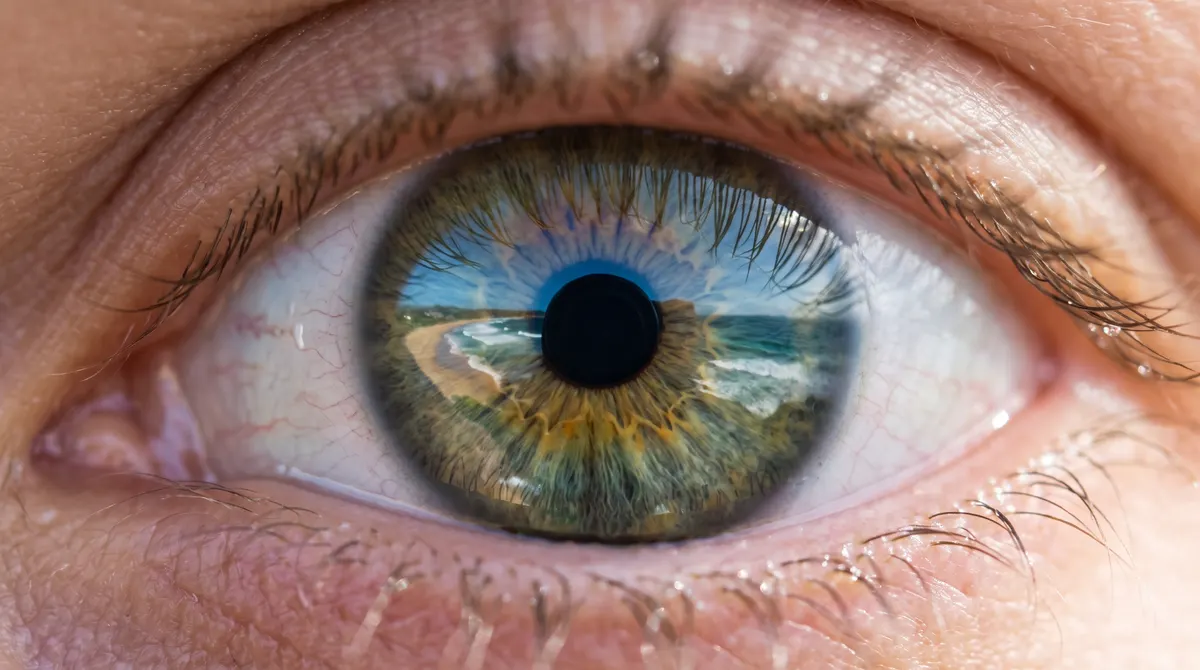
Close one eye and hold a finger at arm's length, a little off to the side. Keep staring straight ahead and slowly move the finger further out. At some point it will vanish. Not blur, not fade, simply disappear, before popping back into view as you keep going. Everyone has that gap, in the same place, and most of us live our whole lives without noticing it.
That small trick is a clue. The sharp, seamless, full-colour scene in front of you is not a direct recording of the world. It is a construction, built by your brain from patchy, upside-down and incomplete signals.
The Front of the Eye: A Living Camera
At first, the eye works a bit like a camera. Light enters through the cornea, the clear dome at the front, which does most of the focusing. It then passes through the pupil, the opening in the coloured iris, which widens or narrows like a camera's aperture.
Behind the pupil sits the lens. Tiny muscles let it flatten or relax into a rounder shape, fine-tuning focus for near or distant objects, a process called accommodation. The focused light lands on the retina, a thin light-sensitive layer lining the back of the eye. Here the camera comparison breaks down, because the retina starts processing the image before the signal has even left the eye.
Rods, Cones and Walking into a Dark Cinema
The retina's light-detecting cells, called photoreceptors, come in two main kinds, named for their shape. Rods are extremely sensitive and handle dim light, but they cannot tell colours apart, which is why a dark room looks grey. Cones need much more light but give us colour and fine detail. They are packed into a small central patch called the fovea, where vision is sharpest.
That is why you can only read small print or study a face properly by looking straight at it. Your wider, peripheral vision relies more on rods. It is excellent at noticing that something moved out of the corner of your eye, and much worse at telling you what it was.
Two kinds of receptor also explain the cinema problem. Walk in from bright sunshine and you are nearly blind for a while. Cones stop being useful in the dark, leaving the job to rods, but their pigment, rhodopsin, is bleached by bright light and takes a good while, commonly twenty minutes or more, to fully regenerate. That is also why astronomers and sailors use dim red light at night: it barely disturbs rhodopsin.
Three Cones, Millions of Colours
Colour vision rests on an elegant shortcut. Rather than a receptor for every colour, we have just three types of cone, most sensitive to roughly red, green and blue light, with heavily overlapping ranges. Every colour you see is worked out by comparing how strongly each responds. Screens mix red, green and blue pixels on the same principle, though the match is less perfect than it seems, as Colour – Why Your Screen and Your Eyes Disagree explains.
The same system explains colour blindness. The most common forms come from an altered or missing red- or green-sensitive cone. The genes involved sit on the X chromosome, so red-green colour blindness is much more common in men, who have only one X and no backup copy. Blue-cone problems exist but are much rarer. Screening often uses Ishihara plates, dotted circles hiding a number that vanishes if your cones cannot separate the colours.
Two Eyes, One World in Depth
Your eyes sit a few centimetres apart, so each gets a slightly different view. The brain compares the two, and the size of the mismatch tells it how far away things are, a process called stereopsis. Hold a finger close to your face and blink each eye in turn: the finger seems to jump against the background, and the closer it is, the bigger the jump.
Two-eyed depth works best up close and fades beyond a few dozen metres. So the brain also leans on clues available to a single eye:
- Nearer objects overlap and hide parts of further ones.
- Parallel lines, like the edges of a road, seem to converge with distance.
- When your head moves, nearby things sweep past faster than distant ones.
The Hole in Your Vision
That vanishing finger comes from the retina's wiring. Every photoreceptor sends its signal onward, and all those nerve fibres gather at one point before leaving the eye as the optic nerve. At that spot there is no room for photoreceptors, so a small patch of your visual field receives no information at all: the blind spot.
You do not see a hole because the brain fills it in, using the surrounding scene and your other eye's view to paint a plausible guess. That is true throughout vision: the brain is constantly filling gaps and making inferences.
The Brain Does the Heavy Lifting
The raw image the eye captures is flat, upside down, constantly shifting and sharp only in the centre. Everything that makes your experience smooth, stable and complete is added later. Signals travel along the optic nerve to a relay station deep in the brain, then on to the visual cortex at the back of the head, where edges are sharpened, motion tracked, shapes recognised, and memory and context used to decide what you are probably seeing. For more on the organ doing that work, see The Human Brain – Three Pounds of Mystery.
Your eyes are also almost never still. Because only the fovea sees fine detail, the eyes make rapid jumps called saccades several times a second, building up a detailed scene piece by piece. During each jump the brain briefly suppresses the incoming image, so you never notice the world smearing every time your gaze flicks from one thing to another.
Why Illusions Are Evidence
Optical illusions show just how much interpreting goes on. In one classic type, two identical grey squares look like different shades because of their surroundings. Your brain is not measuring the absolute light from each square. It compares each patch with its neighbours and makes assumptions about lighting and shadow, which in the real world is usually more useful. Vision scientists treat illusions as serious tools, because a well-designed one exposes exactly which assumption the brain relies on. Each is a small experiment the brain unwittingly runs on itself.
Some common vision problems, by contrast, are matters of geometry. In short-sightedness (myopia), the eye focuses light in front of the retina, so distant things blur. In long-sightedness (hyperopia), the focus falls behind it, and nearby objects suffer most. In astigmatism, the cornea or lens is unevenly curved, more like a rugby ball than a sphere, causing blur at all distances. Glasses and contact lenses add a precisely curved surface that lands the focus back on the retina.
A Picture You Can Trust
A self-adjusting lens, two kinds of light sensor, a three-channel colour system and, above all, a brain that fills gaps and builds a confident picture from imperfect data: that sits behind every glance. Somewhere in your view right now is a patch sending no information at all, seamlessly painted over by a brain that has spent your whole life building you a world you can rely on.


