 Talking Science Podcast
Pain – How the Body Signals Damage
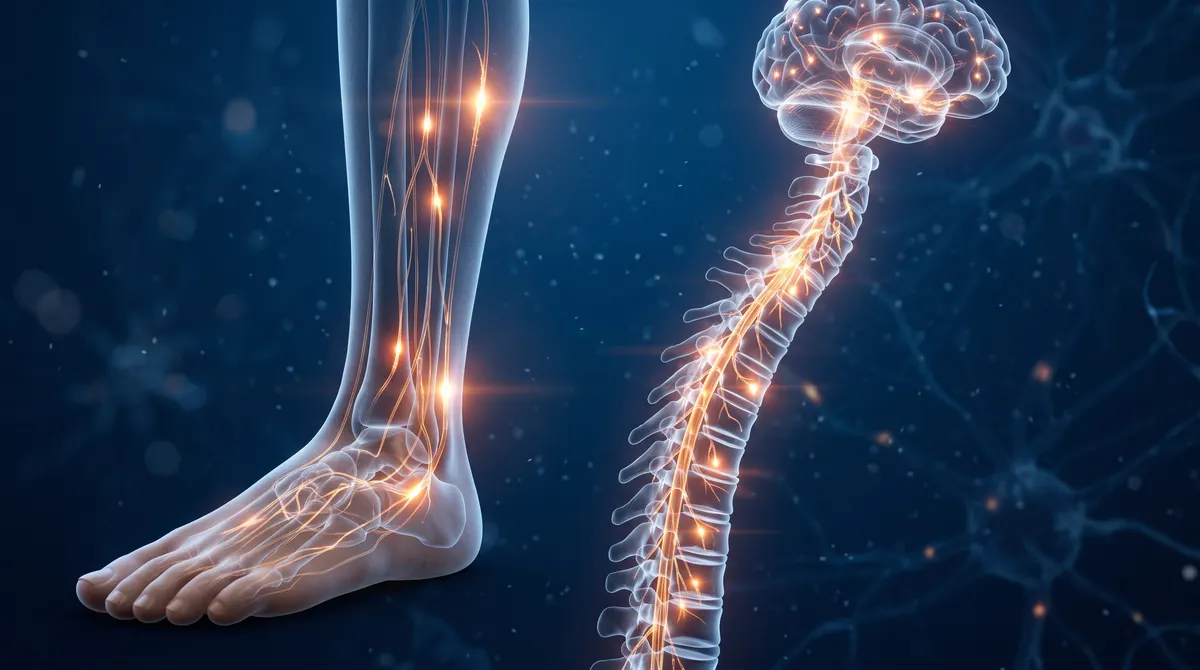
Stub your toe on the leg of the bed in the dark and something odd happens. There is a sharp, bright jolt first, and then, a heartbeat later, a deep throbbing ache rolls in. Without thinking, you grab the foot and rub it, and somehow that helps. You have probably done this a hundred times without asking why pain arrives in two waves, or why rubbing a hurt makes any difference at all.
Those small puzzles point to the real story of pain. It is not a simple wire running from an injury to a feeling. It is a signalling system with several stages, each of which can turn the message up or down, and the final experience is assembled in the brain. Following that signal step by step explains a great deal about why pain behaves the way it does.
A Warning System Worth Having
Pain exists because it protects us. The flash that makes you snatch your hand off a hot barbecue plate, or stops you walking on a sprained ankle, is the body shouting that something needs attention. The rare people born unable to feel pain show how vital that warning is. They burn, cut and break themselves without noticing, wear out their joints, and often suffer serious harm from injuries and infections that never announced themselves.
The bigger picture of why pain is a protector rather than an enemy is covered in Pain – Why It Hurts and What It's For. Here the focus is on the machinery: how the warning is detected, carried and shaped on its way to becoming a feeling.
The Danger Detectors
Threaded through your skin, muscles, joints and internal organs are specialised nerve endings called nociceptors, a name that simply means danger detectors. Different ones respond to different threats:
- extreme heat or cold
- crushing or sharp pressure
- chemicals released by damaged or inflamed tissue
When one of these is triggered, say by treading on a bindi in the backyard, it fires an electrical signal that travels along the nerve towards the spinal cord. The crucial point is what that signal is and is not. It is a message saying "possible trouble down here". It is information about danger. On its own it is not yet pain.
Two Kinds of Wire, Two Waves of Hurt
The stubbed-toe double act comes from the wiring. Some nociceptors send their messages along nerve fibres wrapped in a fatty insulating coat that speeds the signal up. These carry the quick, sharp, well-located first pain that tells you exactly where you have been hurt. Others use thinner, uninsulated fibres that conduct far more slowly. They deliver the dull, spreading, aching second wave that arrives a moment later and tends to linger.
The two waves do different jobs. The fast one is about immediate action: move, now. The slow one is about protection over the coming hours: guard this part, rest it, let it heal.
The Spinal Cord: Reflexes and Gates
The first major stop for the danger signal is the spinal cord, and two important things happen there. The first is the reflex. When you touch something scalding, your hand often jerks away before you are even aware of the heat. That withdrawal is organised by circuits in the spinal cord itself, which act before the message has finished its trip to the brain.
The second is a kind of volume control. In the 1960s the scientists Ronald Melzack and Patrick Wall proposed what became known as the gate control theory of pain. The details have been refined since, but the central idea has held up: signals arriving at the spinal cord can be dampened or amplified before they are passed on. Ordinary touch and pressure signals can partly close the gate on danger signals. That is why rubbing a bumped elbow or a stubbed toe genuinely takes the edge off. You are flooding the system with harmless touch information that competes with the danger message.
The Brain Makes the Final Call
From the spinal cord the signal travels up to the brain, and this is where pain is actually produced. The brain does not just receive the message and pass it on as a feeling. It weighs the danger signal against everything else it knows: the situation, past experience, mood, attention and how threatening the moment seems. Then it decides how much protective pain to create, and where in the body to place it.
The brain can also send messages back down the spinal cord to turn incoming danger signals up or down. This is part of why an injury in the middle of a crisis can feel like very little until later, and why the same knock can hurt more when you are anxious or exhausted. The pain is completely real every time, but its intensity reflects the brain's judgement of danger, not a direct measurement of damage.
The most striking evidence is phantom limb pain, in which people who have lost an arm or leg feel vivid pain in a hand or foot that is no longer there. No danger detectors exist in the missing limb, yet the brain's map of the body can still generate pain located there. It is hard to imagine clearer proof that pain is made in the brain. The wider nervous system behind all of this is explored in The Nervous System – The Body's Wiring.
When the System Turns Itself Up
The system's sensitivity is not fixed. After an injury, the area around it often becomes more sensitive, which is why sunburnt shoulders sting under a warm shower that would normally feel pleasant. Inflammation lowers the trigger point of the danger detectors, and this is helpful in the short term because it encourages you to protect a healing part.
Sometimes, though, the sensitivity does not settle. In chronic pain, which lasts months or years beyond normal healing, the nerves and the brain can effectively learn to produce pain more and more readily. The alarm keeps sounding even when the original threat has gone, like a car alarm set off by a passing breeze. For a long time people whose scans looked normal were sometimes disbelieved or told their pain was "all in their head". Modern pain science offers a more accurate picture: the pain is real, but it is being driven by an oversensitive warning system rather than by fresh damage.
Australian researchers have been prominent in this field. Lorimer Moseley and David Butler's book Explain Pain helped popularise the idea that understanding how pain works can itself be part of managing it. Treatments built on this view aim to retrain the over-tuned alarm rather than only searching for damage that may not be there. Anyone living with persistent pain deserves proper assessment from a doctor or pain specialist, since this is a complex medical area.
A Message, Not a Measurement
Follow a pain signal from start to finish and its strangeness becomes clear. Danger detectors in the tissue send a warning. Fast and slow fibres deliver it in two waves. The spinal cord fires off reflexes and adjusts the volume. Finally the brain weighs it all up and creates the experience of pain, sometimes strong, sometimes muted, occasionally where there is no body part at all. Pain is not a gauge bolted to an injury. It is a carefully processed message from a system doing its best, usually wisely and occasionally too loudly, to keep you safe.


